
26 August 2026 | By James Thomas
Four challenges every organisation must solve to adopt AI safely
Discover four key challenges affecting AI adoption and how organisations can build confidence in their approach.
Read more
By Dave Pierson | 30 April 2026
For a long time, many organisations felt reassured simply knowing they had backups in place for their data. That assumption no longer holds true. Today’s cyber attacks are far more calculated. They do not just aim to disrupt day-to-day operations, they go after recovery itself. Backups are often targeted early because attackers know that when restoration is no longer an option, the pressure to pay a ransom rises fast.
In this environment, traditional backup methods on their own simply cannot keep up. That is why immutability has shifted from just being supplemental to an essential part of modern cyber resilience.
Immutability means that once backup data is written, it cannot be altered, encrypted or deleted until a defined retention period expires. This protection applies universally, regardless of user privilege, administrative access or whether credentials have been compromised.
In practice, immutability ensures that:
• backup data cannot be tampered with during an attack
• recovery points remain intact even if identities or systems are compromised
• organisations always retain a trusted copy of their data
Rather than relying on permissions or process alone, immutability enforces protection directly at the storage layer. This removes one of the most common weaknesses attackers exploit and gives organisations a fixed point of certainty when they need it most.
Traditional backup designs were created for a very different threat landscape. They were never intended to withstand the kind of cyber attacks organisations face today. In many environments, administrators can still delete or modify backups with relative ease. Backup storage is often accessible over standard network connections, which means that once credentials are compromised, recovery points can be encrypted or wiped out entirely.
As cyber attacks have become more deliberate, backups have become an obvious and valuable target. When recovery options are removed, organisations are pushed into difficult decisions under intense pressure. If backups cannot be restored, simply having them in place offers little real reassurance.
The comparison below highlights how traditional backup designs stack up against immutable backup models when put to the test during a real attack.
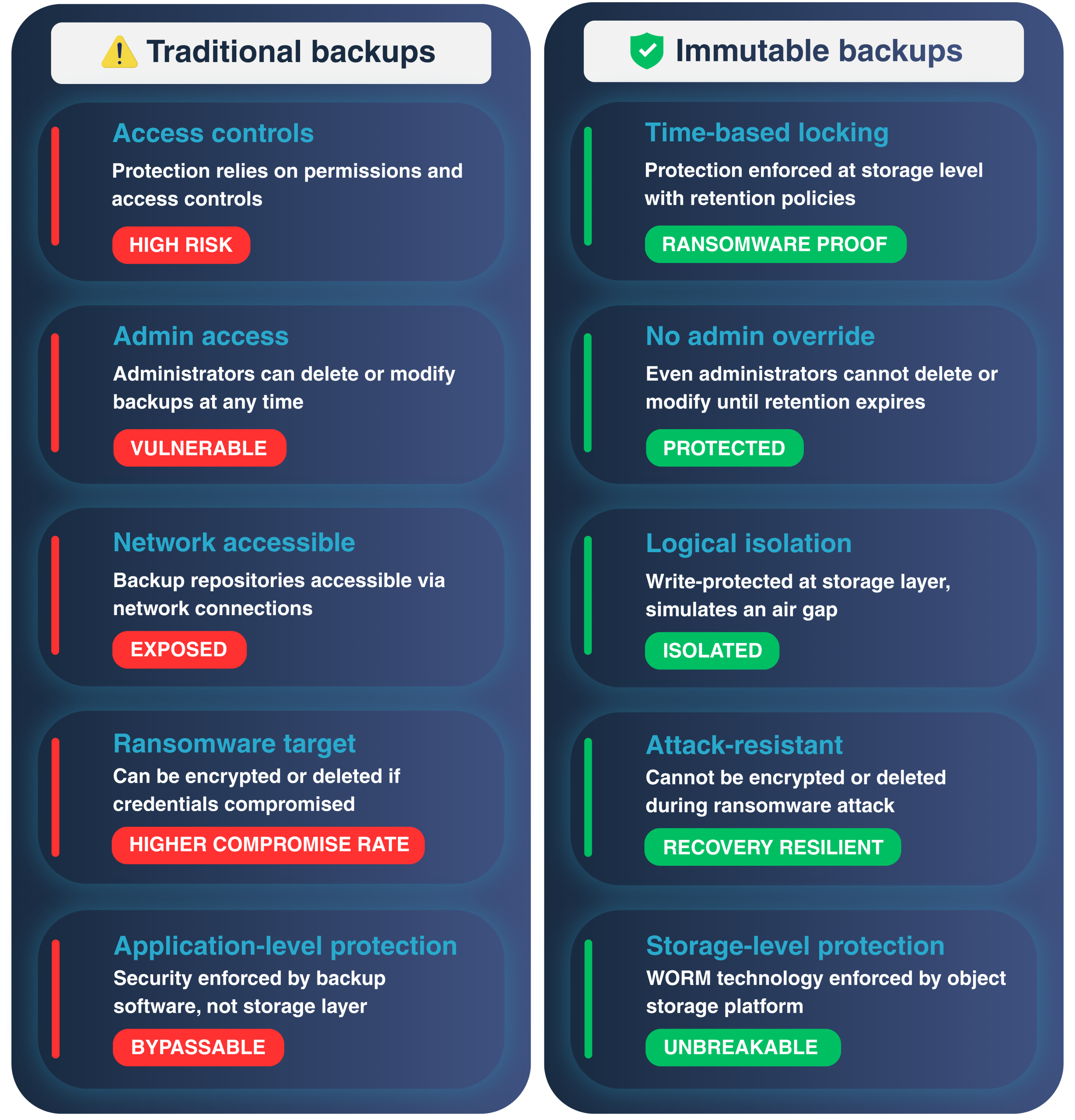
This contrast highlights why immutability is no longer a “nice to have” feature. It directly removes the control attackers depend on to force ransom payments.
Immutability is not designed to stop incidents from happening, it is there to guarantee recovery when prevention is no longer enough. By locking backup data for a defined period, organisations protect recovery at the point it matters most through:
This positions immutable backups as a true last line of defence, supporting faster, calmer and more reliable recovery when it matters most.
Backups only deliver value if they can be restored with confidence. Immutability strengthens recovery in several critical ways.
Ransomware resilience
Even if production systems are fully compromised, immutable backups remain recoverable, removing pressure to negotiate with attackers.
Protection from insider and credential-based threats
No individual, including highly privileged users, can override retention protections once data is written.
Compliance and retention assurance
Retention policies are enforced at the storage layer, reducing reliance on manual controls or user behaviour.
Faster incident response
Organisations can restore systems without first validating whether backups have been tampered with, saving valuable time during critical outages.
Together, these benefits transform backup from a hopeful safety net into a dependable recovery mechanism.
Few organisations operate in just one environment anymore. Data is spread across on premise systems, cloud platforms and SaaS services, and immutability needs to work across all of them.
Today’s approaches allow organisations to apply consistent protection, reduce exposure and align recovery with zero trust principles. This makes it possible to improve resilience incrementally without wholesale change.
Immutability only delivers value if it works across the platforms your data actually lives on. That often means combining native cloud services, hybrid platforms and SaaS protection.
At Bistech, we help organisations design and run immutable backup using technologies such as Azure, Veeam and Druva, ensuring they are implemented correctly, tested regularly and trusted when it matters most.
If you want confidence that recovery will still work under pressure, book a call with the Bistech team today.
26 August 2026 | By James Thomas
Discover four key challenges affecting AI adoption and how organisations can build confidence in their approach.
Read more
13 August 2026 | By Mark Murray
Microsoft MFA is retiring. Discover why passkeys are becoming the new standard and the steps businesses should take before 2027.
Read more
30 July 2026 | By Louis Adams
Discover why patching management alone is no longer enough to protect against modern cyber threats.
Read more