
26 August 2026 | By James Thomas
Four challenges every organisation must solve to adopt AI safely
Discover four key challenges affecting AI adoption and how organisations can build confidence in their approach.
Read more
By James Thomas | 16 June 2026
AI has not quietly entered the workplace, it has accelerated into it.
Across organisations, teams are experimenting in real time, workflows are shifting, and data is moving between systems, people and platforms faster than most businesses can meaningfully track. The pace is exciting, and in many cases transformative, but it also creates a level of exposure that few organisations have fully come to terms with or know where to turn for support.
In many businesses, this is already playing out in small, almost invisible ways. A team member pastes sensitive content into an AI tool to speed up a proposal. Someone connects a new application to automate part of their workflow. Another shares data between platforms to get a quicker answer. None of it feels significant in isolation, and none of it is done with bad intent, but together it creates a picture that most organisations cannot fully see, including shadow AI, data leakage, weak access control and other vulnerabilities across AI systems and connected workflows.
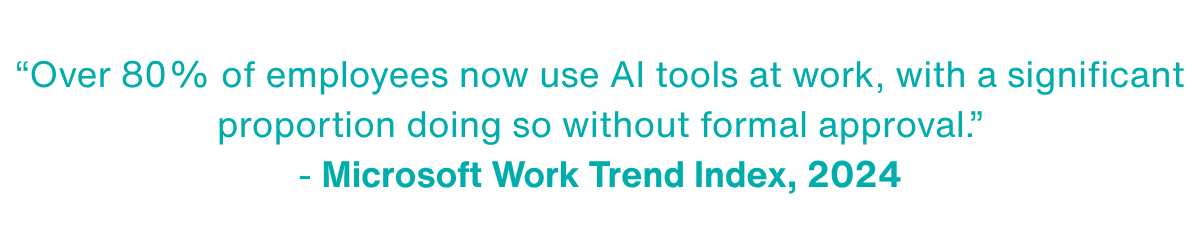
This is not hypothetical. Research suggests that over 80% of employees are now using AI tools at work, often without formal oversight. What feels like small, isolated actions quickly becomes harder to evaluate in real time, and traditional security models rarely keep pace with that level of change. Because the challenge with AI is not adoption, most businesses have already crossed that line. The challenge is understanding what happens next, including whether your network can actually support AI agents at scale.
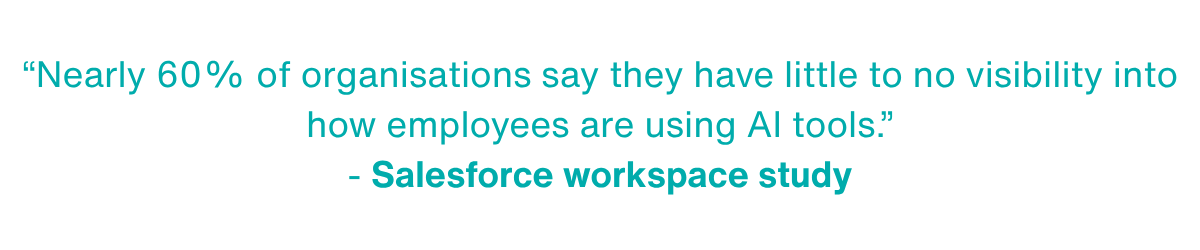
Without clear visibility of how tools are being used, what data is being shared, and where that information ultimately ends up, risk does not present itself in obvious ways. It builds gradually in the background until organisations are forced to react rather than stay in control. This is the context in which Secure Service Edge (SSE) becomes not just relevant, but necessary, especially when combined with unified network security platforms such as Fortinet.
Traditional approaches to cyber security were built around a simpler model. Users sat within a defined network perimeter, applications were largely on-premise, and access could be managed from a central point of control.
Think of a school with a single entrance gate. Once someone passes through it, they can move around freely, whether they should be there or not. That is how many environments still operate. SSE removes that assumption. Instead of relying on one decision at the start, it checks access at every classroom door, each time someone approaches.
In practice, this means that every time a user opens an app, uploads a file, or interacts with an AI tool, SSE evaluates who they are, what device they are using, what data is involved, and what access control should apply at that moment.
Today’s users work across locations, devices and cloud environments, often interacting directly with AI tools that sit outside traditional IT oversight. Security teams need visibility over those services, especially when they are adopted beyond formal IT processes. Forcing that activity through outdated control points is not only ineffective, but it also often introduces friction that people simply work around.
SSE takes a different approach. It shifts security closer to the user, the application and the data itself, applying control at the point of access rather than relying on assumptions made earlier in the session, helping strengthen overall security posture. This aligns closely with SASE, the next-generation networking and security model. This allows organisations to maintain oversight without slowing the business down, which is where most security strategies either succeed or fail.
It is easy to describe SSE as a collection of technologies, but that misses the point. Its real value lies in how those capabilities work together to create a consistent, intelligent layer of control.
In practice, SSE continuously evaluates context. It uses continuous monitoring across users, devices and activity. It considers who the user is, what device they are using, what they are trying to access, and how sensitive the data may be. Based on that context, it makes real-time decisions with automated response capabilities to allow, restrict or adapt access immediately when suspicious behaviour appears.
Capabilities such as zero trust access, web filtering and cloud app control are not applied in isolation. They operate as part of a joined-up approach that ensures policies are enforced consistently, regardless of location or device.
The result is security that feels less intrusive but is significantly more effective. AI can process signals from thousands of devices at once to improve threat detection, and AI-powered surveillance can flag unauthorised access with immediate alerts, allowing for faster automated responses to threats. When combined with secure, AI-ready Microsoft cloud environments, users can move at speed, while the organisation retains control of what matters most.
AI fundamentally alters how people interact with systems. Requests become more frequent, more dynamic and less predictable. Data does not simply sit within applications, it flows between them, often in ways that are difficult to trace without the right controls in place.
This shift introduces a different kind of risk. It is less about a single breach point and more about the accumulation of small, often invisible exposures that, over time, becoming significant. These potential security risks include data breaches, supply chain vulnerabilities and adversarial attacks that can target AI systems. Without effective AI security tools and strict access controls, malicious data can infiltrate training datasets or input data, compromising AI models and leading to inaccurate or harmful AI system’s outputs. Protecting AI systems requires continuous monitoring, enhanced threat detection, and a comprehensive risk management framework to identify vulnerabilities before they escalate.
Organisations without the right level of visibility and control often find themselves asking difficult questions too late. Where has sensitive data been shared? Which tools have accessed it? Could that interaction have been controlled or prevented? Has training data been altered, or has model behaviour changed over time?
SSE helps answer those questions before they become problems. It provides clear visibility into how AI tools are being used, enables control over what data can be shared or processed, and ensures security measures are applied consistently to support compliance when handling sensitive information across the environment. Importantly, it achieves this without introducing unnecessary barriers, which is critical for both productivity and trust.
The reality for most organisations is that AI is already part of day-to-day work, whether it has been formally introduced or not. Teams are finding smarter, faster ways to operate, often without waiting for permission, and that instinct to improve how work gets done is something businesses should be encouraging.
What matters is not slowing that momentum. It is ensuring it happens within a structure that gives the organisation confidence in what is taking place, including using AI to identify potential threats through behavioural pattern analysis while recognising that AI technologies can also be exploited by attackers and used by threat actors, and that successful AI adoption still depends on a people-first strategy.
SSE provides that structure. It brings clarity to what can often feel hidden, and control to what can easily drift unchecked, with built-in risk assessment and the ability to prioritise potential risks so teams can focus on the issues that matter most. More importantly, it does so in a way that supports the pace of modern business rather than working against it.
With the right approach to Managed Security, organisations move beyond simply trying to keep up. They begin to understand their environment in real time, shape how AI is used, and make decisions with a level of confidence that is difficult to achieve otherwise, especially when a data and AI readiness assessment has laid strong foundations.
That shift is subtle, but powerful. It turns security into something enabling rather than restrictive and replaces uncertainty with quiet assurance. When you can see what is happening, trust how it is being managed, and know that the right controls are in place, the conversation around AI changes entirely.
It is no longer something to be cautious of or contain. It becomes something you can fully embrace, knowing you are supported in the moments that matter most, particularly when you book a call with AI security experts to shape a roadmap around your specific environment.
For organisations looking to bring structure and confidence to AI adoption, a discovery call with our Bistech team is a natural next step. It offers an opportunity to step back, understand where risks may sit today, and explore how greater visibility and control can be achieved through AI security best practices without slowing your business down, drawing on lessons from customers navigating similar AI journeys.
26 August 2026 | By James Thomas
Discover four key challenges affecting AI adoption and how organisations can build confidence in their approach.
Read more
20 August 2026 | By Sally Bailey
Sustainable AI goes beyond energy use. Efficient infrastructure, smarter data and the right use cases can help businesses cut costs, reduce wasted resources and gain real competitive advantage.
Read more
13 August 2026 | By Mark Murray
Microsoft MFA is retiring. Discover why passkeys are becoming the new standard and the steps businesses should take before 2027.
Read more