
8 April 2026 | By James Hernon
Global memory shortage: What organisations need to know and how to stay ahead
Global memory shortage is driving higher costs and delays. Learn what your organisation can do to stay ahead.
Read more
By Stephen Dodge | 28 March 2025
Not so long ago, working in a contact centre meant handling a barrage of calls armed with only a sharp memory, keen listening skills, and plenty of patience to deal with frustrated customers.
Things have come a long way since then. Thanks to technological advances, contact centres have become powerful, multichannel hubs that benefit customers and agents alike. And with AI in the mix, the possibilities are greater than ever.
If you’re looking to upgrade your own business’ contact centre, chances are AI has showed up on your radar more than once. But how exactly can it help? How can you get the most out of it? And what should you keep in mind before taking the plunge?
With years of experience delivering custom contact centre solutions across the UK, the Bistech team have seen first-hand how AI is shaping the future of customer interactions. In the guide below, we break down everything you need to know about AI-powered contact centres and how you can unlock their full potential for your business.
A contact centre’s main job is still to answer questions and solve problems, but modern customers expect more than that. They want an interaction that’s personal, helpful, and positive — one that leaves them feeling good, not relieved it’s over.
This is because people today aren’t just after great products; they want amazing experiences to go along with them. In fact, 80% of customers say the experience a company provides is just as important as its products and services. You could offer the best product of its kind, but if the customer experience falls short at any point, it can be enough to drive them straight into the arms of your competitors.
More and more businesses are realising this, offering faster, more personalised, and more valuable interactions to keep customers coming back. And since your contact centre is one of the most direct ways customers connect with your brand, improving these interactions is key to staying ahead of the competition.

Before we explore the impact of AI, let’s start by looking at how most contact centres are run today.
While calling a phone line is still an option, customers can also get in touch through:
Thanks to the flexibility, real-time insights, and cost savings that digital channels offer, many businesses steer customers toward them first. Around 71% use online channels for initial contact, saving phone support for escalations or more complex issues.
To manage these interactions, a business will either host its own contact centre or use Contact Centre as a Service (CCaaS), a cloud-based solution that lets support agents manage multichannel customer interactions through a single platform. Leaders in this space include 8×8 and RingCentral.

Modern contact centres already offer countless benefits for both users and agents, but AI has the potential to take these benefits even further – and with 79% of customer service teams already using it, the transformation is well underway.
Right now, there are two main ways AI can help: by freeing up agents to handle more complex queries and by supporting them with their daily tasks.
“Virtual agents” are — as the name suggests — AI-powered chatbots that handle interactions just like your regular agents. Examples include 8×8’s Intelligent Customer Assistant and RingCentral’s RingSense AI.
Virtual agents can use Natural Language Processing (NLP) to understand customer queries and respond in a way that’s both accurate and contextually relevant. By handling simpler tasks like answering FAQs, they free up your human agents to tackle more complex issues.
As an example, one of our customers in the motor dealership industry realised that nearly 45% of their calls were about simple MOT queries. Their agents were stuck dealing with tasks that could easily be automated, leading to wasted time and resources. When we implemented 8×8’s AI-driven automation in their centres, their agents’ capacity nearly doubled overnight.
AI can also work behind the scenes to support agents before, during, and after their customer interactions, much like a research assistant. Here’s how:
Agents need to keep up with constantly changing details like current offers, shipping times, and technical information, all while improving their customer service skills. AI can help by giving agents up-to-date information based on the customer’s message, which makes their jobs easier and ensures the information they provide is both accurate and consistent.
By analysing a customer’s inquiry and past interactions, it can route them to an agent who understands their history or is best equipped to solve their issue.
AI can use sentiment analysis to detect emotions during a conversation, which agents can use to adjust their approach on the spot. It can also escalate difficult conversations to more experienced agents if needed.
AI can analyse past data to predict call volumes and help contact centres better allocate resources and optimise schedules. This leads to smoother operations, reduced stress for agents, and better service for customers.
AI can monitor conversations in real time, offering insights into both agent performance and customer satisfaction. This makes it easier for managers to spot areas for improvement and provide targeted coaching to help agents improve.
AI can predict a customer’s needs based on their past interactions and behaviour. For example, it might foresee a potential issue or anticipate the next question the customer may have, leading to a quicker resolution.
After an interaction, AI can schedule follow-ups or send personalised messages, like reminders for product updates or customer satisfaction surveys, tailored to the specific customer.
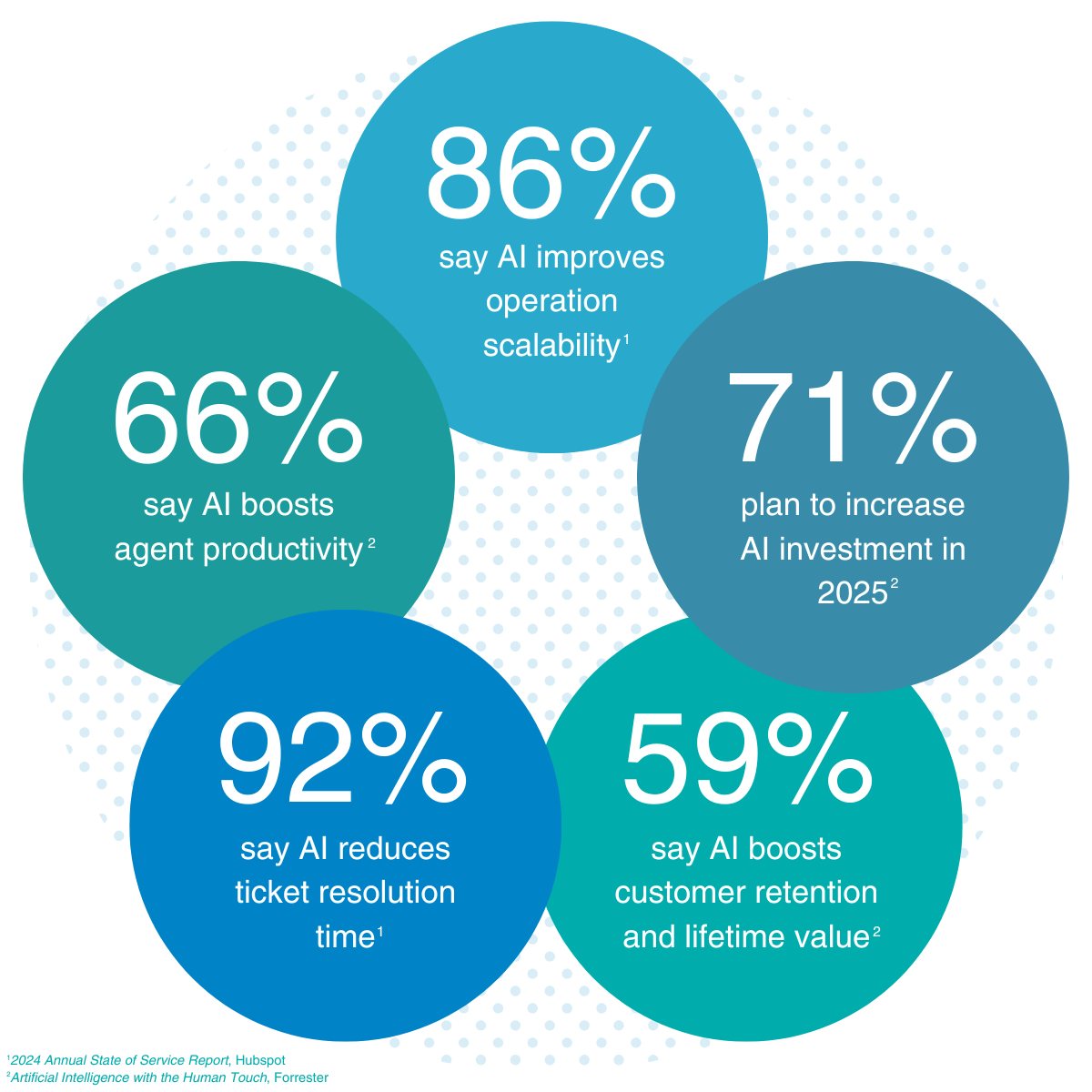
AI has a lot to offer, but like any technology, there are a few things you should consider before committing fully.
With some economists predicting AI could replace millions of jobs in the coming years, many are wondering if human agents will soon be a thing of the past.
The reality? While AI is an incredibly powerful tool, it’s unlikely to ever fully replace human agents.
AI excels at handling simple, direct questions, but it can struggle with adapting to different situations, thinking critically, and understanding context. This means it can give vague or incorrect answers to more complex queries.
Then there’s the human touch. When people are confused or frustrated (not uncommon in customer service!), they want to feel heard and understood. Empathy and emotional intelligence are uniquely human skills, something AI, no matter how advanced, simply can’t replicate.
As a result, 95.5% of people still want the option to speak to a human when needed.
The best approach isn’t to replace human agents with AI, but to use AI as a tool to support them by handling routine tasks and assisting with more complex ones. This gives businesses the speed and efficiency of AI, without losing the depth, understanding, and personal connection that customers look for.
Even with developers making great strides in improving security, there are still some risks to using AI in contact centres. Here are the main ones to keep in mind:
The good news is that there are ways to reduce these risks. Choosing solutions with strong security guardrails in place, running regular audits, providing thorough employee training, and having clear GRC policies can all make a big difference. You may also want to partner with a trusted managed security specialist, who can provide expert support and make navigating these challenges easier.
AI is still a relatively new technology, and a lot of customers aren’t sure whether they can trust it — or the companies using it — with their data. According to a report by Salesforce, only 42% of customers trust businesses to use AI responsibly, 64% think companies are too careless with their data, and 72% say it’s important to know if they’re talking to an AI agent.
To build trust, you need to show customers that their data is safe, and that AI is being used in ways that genuinely benefit them. Here’s how:
The guide above gives you a general introduction to AI-based contact centres, but there’s a lot more to consider before bringing one into your business. If you want to maximise the benefits and minimise the risks, your business needs a contact centre solution that fits its size, budget, and needs perfectly. Just as importantly, it needs expert setup and support to keep things running smoothly from day one. That’s why it pays to work with a provider you can trust.
At Bistech, we work with world-class CCaaS developers to deliver the exact AI-powered solution your business needs — one that’s intuitive, efficient, and designed to get results. Built around your business’s priorities, it will improve first contact resolution, reduce costs, boost agent satisfaction, and much more, all while keeping your customer data secure.
But we’re more than just a provider. We build strong partnerships with our clients, going the extra mile to get you exactly what you need, when you need it. Whether it’s expert advice or hands-on support, we’re with you every step of the way — and with a 95% customer retention rate year after year, our results speak for themselves.
If you’d like to see how partnering with us can make a difference, read our case study on Creed Foodservice and book a call with us today.
Sources:
8 April 2026 | By James Hernon
Global memory shortage is driving higher costs and delays. Learn what your organisation can do to stay ahead.
Read more
31 March 2026 | By Sally Bailey
Our Inside Track magazine is back after a number of years away, and we are pleased to share the latest edition with you here.
Read more
12 March 2026 | By Jesse Brett
Microsoft have announced the launch of Microsoft 365 E7, known as The Frontier Suite. Learn more about the new capabilities here.
Read more